Apple Reference Image: Trust But Verify
Apple published a whitepaper about their new approach for verifying photos are what they claim to be and how they might have been edited.
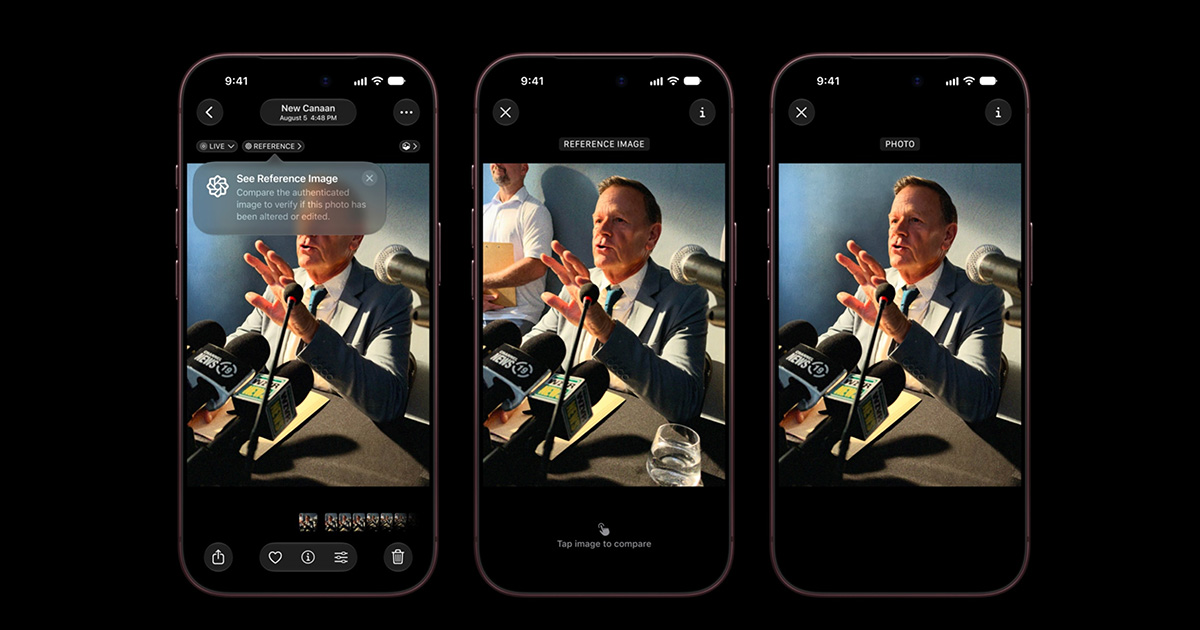
Earlier this week, Apple published a white paper about their newly released Apple Reference Image technology.
In it, the Apple Security Engineering and Architecture (SEAR) and Camera & Photos teams provide an overview of their reasoning on the importance of proof of authenticity of a photograph in the age of AI-powered editing. They also outline their solution to providing a verifiable chain of proof of the origin and provenance of an image as captured by Apple camera hardware. If that sounds as interesting to you as it does to me, you should read the whitepaper linked above.
Because you can’t be absolutely certain a digital image you’re looking at is unedited on the word of the photographer or publisher alone, an image captured with Apple Reference Image enabled can be traced back to its original pixels and show you exactly what it looked like at time of capture. You can know that a real photo has been merely cropped or color corrected, because it provides a link to the original image with Apple’s attestation. You can also be reasonably certain that an image was not likely AI generated.
Note: It could still be possible that an image captured by Apple hardware is of an AI generated image. This is something I’ve taken steps to detect in my Captured by ProofRoll™ system. But there is currently no way to be 100% sure - aside from human intuition - that an image isn’t AI. We can get pretty close, though. (For example, by using SynthID.)
Ultimately, Apple has the great benefit of full hardware and software integration. My solution in ProofRoll, like Apple Reference Image, uses the Secure Enclave to store the signing keys. And ProofRoll can revoke keys for known abusing devices. But Apple’s solution is much more complete, e.g. by factory certifying the camera sensor hardware and encoding that data into each photo’s signature, using ObliviousHTTP for strict privacy, and using Private Cloud Compute to store the digital photo negative.
However, ProofRoll’s system works with any iPhone that the app supports, whereas Apple Reference Image only supports 18 Pro/Pro Max (granted, this is due to the aforementioned hardware signature component). I think it’s also likely that Pro iPhones will be the only supported models for Apple Reference Image, as this is mostly a professional need.
As someone who has been interested in digital photography and content provenance for a very long time, but didn’t study it as deeply as the researchers who wrote the whitepaper, the whole piece is an insightful read. I still think ProofRoll’s solution has its own merits, and I’m also looking forward to seeing how/if Apple Reference Image can provide the fundamental layer of authenticity, with ProofRoll’s system as an additional layer of assurance.
Further reading:
- Fstoppers for the photography angle: https://fstoppers.com/gear/apple-reference-image-how-iphone-18-pro-proves-photo-real-904649
- TechCrunch: https://techcrunch.com/2026/09/09/apple-has-a-new-way-prove-your-iphone-photos-arent-ai-slop/
- ObliviousHTTP: https://www.rfc-editor.org/info/rfc9458/
- SynthID: https://deepmind.google/models/synthid/